leonyokoyama のすべての投稿
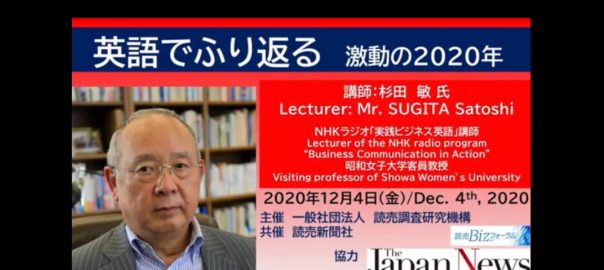
【杉田敏さんの解説で2020年の新語・流行語を振り返る】
こんばんは、岩田です。
12月4日、「読売Bizフォーラム東京オンラインゼミ『英語で振り返る 激動の2020年』」なる無料ライブ配信が行われました。
NHKラジオ「実践ビジネス英語」の人気講師・杉田敏さんが、この2020年、新型コロナウイルスや米大統領選挙で、新たに生まれた言葉や、よく使われた表現、流行語などを紹介・解説してくれる内容となっています。
事前申し込みのオンライン配信で、私は申し込んではいたのですが、当日参加することができず。でも、その後に無料配信してくれいるので誰でも見ることができます。URLはこちら。
1時間半とちょっと長いのですが、これは非常に役に立ちました。
例えば、新型コロナウイルスの流行で頻繁に使われ、日本の流行語大賞候補にもなった「ソーシャルディスタンス social distance」は、「ソーシャルディスタンシング social distancing」が正しい表現だと。
「social distance」は、「出身階級・人種・性別に関する他者との社会的・心理的距離」を表すもので、「social distancing」は「物理的距離」を示すもので、コロナにおいてはこちらがふさわしいといったことや、世界保健機関(WHO)は意味を明確にするため、「フィジカル・ディスタンシング」(physical distancing)の表現を推奨したけれど、なかなか浸透しないなどの話も。
あと、「質疑応答」の内容がすごくためになりました。特に次の3つが。
・「英字新聞・雑誌の効率的な読み方を教えてください」
・「もっとも最近知った単語は何でしょうか」
・「AI時代に生き残れる(求められる)のは、どういう資質を持った通訳・翻訳者でしょう」
これらに対する杉田さんの回答はぜひ動画をチェックしてみてください😄
仮定法2 倒置とwere to / should
・
こんにちは!
前回は、仮定法の基本について解説しました。
本日は仮定法の倒置と、were to / shouldをif節に用いた仮定法について解説します。
【ifの省略(倒置)】
以下のように仮定法の文は、if節と帰結節の組み合わせが基本でした。
[例文1]
If I were president, I couldn’t stand up to its heavy responsibility.
「もし私が大統領だったら、その責任の重さに耐えられないだろう」
上記のような仮定法の文は、Ifを抜いて主語と動詞を倒置することがあります。
特に書き言葉でよくみられます。
[例文1]
Were I president, I couldn’t stand up to its heavy responsibility.
「もし私が大統領だったら、その責任の重さに耐えられないだろう」
[例文2]
Had I stayed at home on that day, I would have been crushed under the collapsed house.
(=If I had stayed at home on that day, ~)
「その日家にいたら、倒壊した家に押しつぶされていただろう。」
ルールとして、語順を倒置可能なのはif節の動詞が”were””had””should”のみなので気をつけましょう。
※shouldの倒置例については次の次の項参照
【if節に”were to”】
if節が“If S were to V”となると、特別なニュアンスが付加されます。
まず一つ目は、可能性が限りなく低いことを仮想して、”それが起こったらこうなる”というニュアンスです。
[were to 1 / 可能性が限りなく低い]
*例文
If all the human were to disappear suddenly, what would the world change?
「もしすべての人間が突然姿を消したとしたら、世界はどう変わるでしょうか?」
二つ目は、“If you were to V”の形で、丁寧なお願いのニュアンスになります。
これは1の可能性が限りなく低いニュアンスを考えてみるとわかると思いますが、相手が「お願いをきいてくれる」ことを当たり位前と考えておらず、「もしも(万が一)やってくれるのであれば」というニュアンスになり、丁寧になります。
[were to 2 / 丁寧なお願い]
*例1
If you were to come to see my son, he would be very happy.
「もしあなたが私の息子に会いに来てくれたら、息子は大喜びでしょう」
*例2
We would be very helpful if you were donate some money.
「幾らかお金を寄付してくだされば、とても助かります」
【if節に”should”】
if節にshouldが入った形は、「万一〜ならば」という推量のニュアンスが加わります。
なお、shouldはshallの過去形ですので、「If S should V(原形)」で仮定法過去として機能します。
[例1]
if you should change your mind, you could contact us anytime.
「もし(万が一)気が変わったら、いつでもご連絡ください」
[例2]
If you should die, I couldn’t bear with the sorrow.
「(万が一)あなたが死んだら、悲しくて耐えられないでしょう」
[should 倒置の例]
Your family would be compensated by the insurance should anything happen to you.
「(万が一)あなたに何かがあった場合、ご家族は保険によって補償を受けられます」
【shouldとwere toのニュアンスの違い】
共に可能性の低いニュアンスを与える”were to”と”should”のニュアンスの違いについて説明します。
一言で言うと、”should”より”were to”の方が限りなく可能性が低いです。
たとえば、「もし太陽がある日消滅したら」や先ほどの例の「全ての人間が消えたら」は起こる可能性は限りなく低いです。ほぼあり得ないですよね。このような場合はwere toを使います。
shouldの場合は、例を見てもわかるとおり、まだ「ありうる」範囲での「万が一」なのがわかると思います。たとえば「あなたが死んだら」や「気が変わったら」は、可能性は低くても現実の生活の中で起こりうることですよね。
本日は倒置と”were to” “should”について説明しました。
それではまた!
TikTok and Its Influence in Year 2020
Hello there, I hope you are doing well.
A new update regarding the Go To Campaign has been released.
Read what’s below to find out more!
Following the latest news regarding the exclusion (排除) of Sapporo and Osaka from the Go To Campaign, the government now plans on suspending the whole campaign entirely from the 28th of December to the 11th of January. As the country is facing its third wave, local government officials have encouraged establishments to close earlier than usual, as well. Traveling within the country isn’t banned, but highly discouraged.
ー初めにー
Today’s Fill-In-The-Blanks Quiz:
Here’s last week’s song:
(Fast forward to 1:24)
One thousand tired people all scattered like rats
And there’s a drunk man sleeping in a pile of trash
He hears the sounds of karaoke and a Mercedes Benz
He wakes up and checks his reflection in a broken glass
Here’s this week’s song:
(Fast forward to 1:44)
But _____ are breaking, the ____ are raging on
And I have_____ my glasses off
You got me ________, and you’re turning it into a ____
A half empty ____; Don’t make me laugh, I’ll….
ー続いてー
Today’s Idiom:
“rose-colored glasses”
This is not a common metaphor (隠喩), but it’s quite interesting! This phrase means “to look at something optimistically”. Something that would be great for all of us to do, especially during the situation we’re facing. For me, this song helps me see the world through rose-colored glasses:
Just be careful with how you use it or how others use it because it could also be meant negatively or sarcastically (冷笑的)
Here’s a sample dialogue:
A: Looking at the break-up through rose-colored glasses, I can finally do what I love again. Like playing tennis and baking…
B: Yeah, I agree! You can also start playing video games again!
A: Oh, no.. we used to play video games together! I miss her now!
I hope this helps!
ー最後にー
Today’s Column:
https://www.bbc.com/culture/article/20201216-how-tiktok-changed-the-world-in-2020
No one can disregard the fact that the phone application, “TikTok” has significantly played a huge role in 2020. Perhaps the Coronavirus has helped it become more popular. It has made a lot of people turn into content creators, and businesses advertise their products. It has also become famous because of its feud against the US and how it’s against their online privacy rules. Do you agree or disagree with this?
Remember to take care of yourself and stay safe.
Ryo
このidiom、面白い! 使えそう!! (11)
皆さん、こんにちは。 M.Mです。
前回は、
私たちの生活に
馴染みの深い猫(cat)を
使用したidiomを
ご紹介致しました。
今回は、
犬(dog)を使用したidiomを
ご紹介致します。
前回までは、
1900年代アメリカが起源の、
身近な動物を
使用したidiomをご紹介致しましたが、
今回は、
やはり英語の起源であるイギリス、
そして、時代ももっと昔にさかのぼります。
「go to the dogs」
意味:
「健康や見た目を損なう」
「自分自身をダメにする」
使い方:
He used to a handsome film star, but now he has gone to the dogs.
訳:
彼はかつてハンサムな映画俳優だったが、今ではそれは損なわれた。
1500年、
当時の人々は、
人間に必要ない、
美味しくない
あるいは、
古くなってダメになり、
食べられない
と思われる食物を
犬に与えていました。
そこから、
ダメになったものは、
「犬に行く」
となり、
このidiomが生まれました。
現在においても身近な動物である犬は、
昔から私たちと共に生きて来たので、
実はたくさん
犬を使用したidiomがあります。
今後もまた、犬に関する
他のidiomも
ご紹介していきたいと思います。
本日も最後まで読んでいただきありがとうございました。
M.Mがお送りしました。
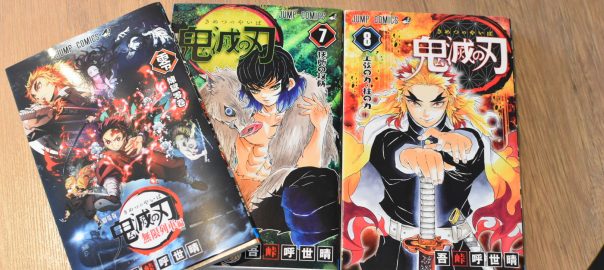
【『劇場版「鬼滅の刃」無限列車編』のグッとくるところを日英で紹介】
こんにちは、岩田です。
『鬼滅の刃』のアニメは全話視聴し、コミックスも全巻持っている私は10月16日の映画公開初日に行ってきました。
12月14日の今現在の情報ですと、『劇場版「鬼滅の刃」無限列車編』の興行収入は302億円を突破。歴代ランキングの1位に輝いている『千と千尋の神隠し』の308億円(興行通信社調べ)まで迫ってきました。
というわけで、本日は『劇場版「鬼滅の刃」無限列車編』の感想を日英でご紹介!
ちなみに『鬼滅の刃』の英語名は「Damon Slayer(鬼・悪魔殺し)」です。
—
ずーーーっと目が離せませんでした。ひと言でいうとただそれだけ。
I couldn’t take my eyes off the film all the time. That’s it.
本編は単行本の7・8巻の内容。ストーリー知ってるし、観に行かなくてもいいかなってちょっと思っていたけれど、心の底から行った価値がありました。
The movie is the content of volume 7 and 8. I already knew it so I thought I didn’t have to go see the movie. However, it’s worth going.
作画、「水の呼吸」の北斎浮世絵的なビジュアル、声優陣、梶浦由紀さんの曲といい、やっぱアニメのクオリティの高さを再認識。そして名言が散りばめられています。
The drawings like Tanjiro’s special moves are great. It’s like the Great Wave by ukiyo-e artist Hokusai Katsushika. I like voice actors&actresses and the musics by Yuki Kajiura. What amazing qualities! And the anime has tons of inspiring quotes.
「生まれついて人よりも多くの才に恵まれた者は、その力を世のため人のために使わねばなりません」by 煉獄・母
“If you’re born with a lot of talent, you have to use it for the public good” by Rengoku’s mother
「ああ……ここに居たいなあ ずっと」by 炭治郎
“Oh…I wanna stay here, forever…” by Tanjiro
炭治郎のセリフはせつなかったです。
I was filled with heartrending sorrow when I heard his line.
仮定法1 仮定法の基本
・
こんにちは!
今日は仮定法について説明します。
【仮定法とは?】
話し手が文の内容をそのまま事実として述べる方法は、「直説法」といいます。
[直説法の文]
If you can come to the party tomorrow, please call me.
「もし明日のパーティーに来れるなら、電話してください」
この文章は「明日あなたは来れるかもしれないし、来れないかもしれないけど、もし来れるのであれば電話して」という意味ですよね。つまりあり得ない話や起こりそうもない話ではないということです。
一方「仮定法」は、ありえないことや、起こりそうもないことを仮想して述べる方法です。
[仮定法の文1]
If I were rich like you, I could eat a big steak every day.
「もし私があなたのようにお金持ちだったら、毎日大きなステーキを食べられるのに」
上記の文では、「私はお金持ちではないけれど、もしあなたのようにお金持ちだったら〜」という意味になっており、あり得ないことを表しています。
[仮定法の文2]
If there were no wars, would the world become peaceful?
「戦争がなかったら、世界は平和になるのでしょうか?」
上記の文では「戦争がなくなる可能性は限りなく低いが、もしも無くなったら〜」というように、起こりそうもないこと(限りなく可能性の低いこと)を仮定しています。
【仮定法過去の文の作り方】
ここでは、「仮定法過去」の文の作り方を解説します。
注意して欲しいのが、「過去」とついていて、実際に過去形を使うのですが、文の時制は現在形です。
まず、If節は過去形になります。
Be動詞の場合、主語が三人称単数でもwasではなくwereになります。
一般動詞は普通に過去形にすればOKです。
帰結節の方は「S+[would/could/should/might]+原形」となります。
[If節がBe動詞の例]
If he were not mean, most of the classmates would recommend him as a leader.
「もし彼が意地悪でなければ、クラスのほとんどが彼をリーダーとして推すだろうに」
[If節が一般動詞の例]
If I had some special talents, I wouldn’t lead a boring life like this.
「もし私が何か特別な才能を持っていたら、こんな退屈な人生を送ることはないだろうに」
【仮定法過去完了】
先ほどの仮定法過去(現在時制)に対して、仮定法過去完了では「過去時制」です。
If節は過去完了形になります。
帰結節は「S+[would/could/should/might]+現在完了形」となります。
[仮定法過去完了の例]
If he had not gone to the war, he might not have been dead.
「もし戦争に行っていなければ、彼は死んでいなかったかもしれないのだが」
上記の例で「もし戦争に行っていなければ(過去の話)、彼はきっと今も生きていただろうに(今の話)」というように時制をずらしたい場合は、If節は「仮定法過去完了」帰結節は「仮定法過去」にします。もちろんその逆も可能です。
[時制がずれる場合]
If he had not gone to the war, he would be still alive now.
「もし戦争に行っていなければ、彼はきっと今も生きていただろうに」
本日は仮定法の基本について説明しました。
それではまた!
Break A Leg?! What?!
Hello there, I hope you are doing well.
A few more weeks until Christmas! Do you have any plans for Christmas Eve and Christmas Day?
https://japantoday.com/category/sports/japan-pledges-support-to-vaccinate-tokyo-olympic-athletes
Let’s start today’s article with an update regarding the Olympics. The government has pledged/promised to vaccinate athletes, volunteers and the staff members who will come and help with the Olympics. It’s a good initiative to help the participants and the audience feel safer. However, it’s been a concern of those who have read this news that the government will use tax money for the vaccines. What’s your opinion about this?
ー初めにー
Today’s Fill-In-The-Blanks Quiz:
Here’s last week’s song:
(Fast forward to 0:19)
Oh tell me, tell me, tell me how to turn your love on
You can get anything that you want
Baby, just shout it out, shout it out
Baby, just shout it out
Here’s this week’s song:
(Fast forward to 1:24)
One thousand____ people all scattered like ____
And there’s a drunk man ______ in a pile of trash
He hears the sounds of karaoke and a ________ ____
He wakes up and checks his reflection in a _____ glass
ー続いてー
Today’s Idiom:
“break a leg”
It’s a very common phrase that is used now by a lot of native speakers! It means, “good luck”! The reason why is because people believe it’s bad luck to tell someone “good luck” or something like that because it would make the other person feel pressured and nervous, so in replacement, they choose a phrase that would sound bad, but the intention is good.
Here’s a sample dialogue:
A: I’m going to deliver a presentation to foreign investors next week!
B: Don’t worry, have enough rest, and break a leg!
A: Thanks! I’ll stay at home this weekend to work more on my presentation notes!
This phrase is more casual than formal and here’s a visual video explanation of the phrase:
I hope this helps!
ー最後にー
Today’s Column:
https://www.bbc.com/news/in-pictures-55222730
Before the year ends, let’s look back at the winners of the Earth Photo competition. These are photos taken all over the world and they look really mesmerizing. It’s nice to be reminded that the world we live in, despite the problems, is beautiful. My favorite photo is the old man looking at the distance. I just love the colors and the composition of the photo! What’s your favorite?
Remember to take care of yourself and stay safe.
Ryo
【演繹と帰納からみる、英語学習の成否】
【演繹と帰納からみる、英語学習の成否】
演繹と帰納
難しいですが、英単語をみるとわりとシンプル。
ダクト(送風管、送風路)は、天井のコンクリートむき出しにしてあるレストランなんかにありますよね。ダクト(duct)の語源は導くこと、引くこと。
演繹 = deduct = de + duct
de(離れる)duct → 1つの理屈からダクト通って外に出る → 全ての事象に1つの理屈をあてはめる
帰納 = induct = in + duct
in(中に)duct → 多くの事象から、ダクトを通って(inして)1つの真理にたどり着く → 多くの事象から共通するものを探して、仮説を立てる
________
★演繹・deduction・1つの理屈をあてはめる
理屈1 「酒を飲むのはとても良いことである」
→ 横山礼恩は酒浸りである
→ A. 横山礼恩は日々善行を重ねている q.e.d
※演繹法は前提の理屈を間違うと結論を誤る。
_________
★帰納・induction・いくつかの起こった事から真理を導き出す
現実1 「酒を飲むと何も覚えてない」
現実2 「酒を飲むと大金を失う」
現実3 「酒を飲むとどこかしら怪我をする」
現実4 「酒を飲むと信頼を失う」
現実5 「酒を飲むと翌日何もできない」
現実6 「酒を飲むと痛風になる」
→ 仮説)酒は良くないかも
_________
★ 英語学習の成否を deduction, inductionで考えてみる
Deduction (1つの理屈をあてはめる)
理屈1「英語はコツコツ音読すれば、しゃべれるようになる」
→ Aさんは、コツコツ音読を続ける
→ A. Aさんは英語学習に成功する q.e.d
※ これはほぼ、間違いなく起こってきました。
_________
Induction(起こっているいくつかの事から真理を仮定する)
Aさん 「わかっちゃいるけどやれない」
Bさん 「仕事が思ったより忙しくて」
Cさん 「他にもいい方法があるのでは?迷う」
Dさん 「机に向かうとやる気が失せる」
Eさん 「先生が気に入らない」
Fさん 「コツコツ続けるのが苦手」
Gさん 「一度やめるとどうでもよくなる」
Hさん 「3日やるとどうしても飽きる」
Iさん 「やり始めると8時間くらいやっちゃう」Jさん 「地味な作業が好きで興奮する。もっと宿題を出して欲しい」
→ 仮説)どうやら継続は普通の人はできない。
________
「英語は音読続けられれば、しゃべれる」
deductiveに考えれば、本当にそうです。
でも、英語指導の現場から inductive に見ると、
「普通の人は継続できない」
これをどう考えるか、ですよねぇ。
ただ、英語って音読すれば絶対に上手くなるんだ(そりゃ、やり方や題材の選び方はありますよ)
でも、それを継続することが普通は難しい、
と知っておくだけでも違うと思います。
このidiom、面白い! 使えそう!! (10)
皆さん、こんにちは。 M.Mです。
前回、前々回は、
動物の関連するidiomを
ご紹介致しました。
また、
両者とも
起源は
1900年代アメリカでした。
今回も、
同じ1900年代アメリカが起源の
現代ではペットにされている
身近な動物、
猫(cat)を使用したidiomを
ご紹介致します。
「fat cat」
意味:
「お金持ち」
「寄付者」
使い方:
Maybe we can get some fat cats to contribute money for thE new gym.
訳:
きっと新しいジムに寄付してくれる寄付者を得ることができるだろう。
1902年、アメリカで、
某お金持ちが、
政治家になりたいという候補者に
莫大な政治資金を
寄付した事が
起源になります。
fatというのは、
2つの理由から
使用されました。
1. 寄付者はもちろん裕福であり、
皆のお腹周りが、大きかった事
2. その人々のお財布が、
いつも分厚かった事
また、
catは、
特に意味はなく、
fatに対して、
catの音が韻を踏んでいて、
しっくりくるため、
他の動物ではなく、
catになりました。
今回は、
馴染みのあるcatを
使用したidiomでした。
実際に、
太った猫の事も
fat catと言いますが、
区別をつけるために、
fatty catと言っても良いでしょう。
本日も最後まで読んでいただきありがとうございました。
M.Mがお送りしました。