Some of my friends have already received the face masks distributed as per order by the PM. Be sure to check your mailbox this week or the next!
ー初めにー
Today’s Riddle:
If your answer was “a towel”, then you got it right!
Why?
After you take a shower, your body would be wet, but your towel is dry. After using it, your body is dry, but your towel is wet. Easy!
For this week, here’s the riddle:
“Mr. Smith has 4 daughters. Each of his daughters has a brother. How many children does Mr. Smith have?”
*Hint
I would usually advise against this, but if you translate this to Japanese, it should make the riddle much easier!
ー続いてー
Today’s Conversational Point:
For today, we will be talking about pauses before we speak in a conversation. I’ve read articles and watched videos about it, but here are two sources that I found to be very helpful. If you have time, give them a try, too!
Basically, it’s saying that it takes about 2 seconds for the next person to answer another person’s question or to continue where the conversation was going. The author of the article above observed people from different countries speaking different languages and has came to the conclusion that in almost all languages, the duration of the pause is almost the same. So, the next time you speak English, try to think that the conversation is in Japanese, except you’re speaking in English. Hopefully, it would help you lessen the pause in between!
In the article above, it says that the EU is slowly softening its lockdown. It won’t go back to where it was before when things were still normal. Instead, it’s going to a new and vague/unclear normal. No one know what that really means as of now. One thing for sure is that even after the lockdown, some countries would still enforce people traveling inbound would be put under quarantine. Also, it is mentioned in the article that President Trump will stop funding WHO. What are your opinions regarding these matters?
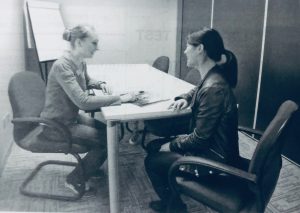
They’re having a meeting now(彼女らはミーティングを行っている) They’re facing each other(彼女らは向かい合っている) They’re sitting across from each other(彼女らは向かい合って座っている) They’re wearing suits(彼女らはスーツを着ている) One of the women is showing a document(女性の1人は書類を提示している)
上記のように英語で考えられるようになればベストですが、最初は日本語でもかまいません。
実際の問題は、
(A) They’re moving some furniture. (彼女らは家具を動かしている) (B) They’re entering a meeting room. (彼女らは会議室に入ろうとしている) (C) They’re sitting at a table. (彼女らはテーブルのところに座っている) (D) They’re cleaning the carpet. (彼女らはカーペットを掃除している)
で、(C)が答えです。
正解の「They’re sitting at a table(彼女らはテーブルのところに座っている)」は、私が予測した「They’re sitting across from each other(彼女らは向かい合って座っている)」と表現が近いです。
Are you keeping social distance? Are you putting on a mask? Are you trying to stay home except when it’s necessary? Keep going like that to overcome the coronavirus! 一人一人の協力で、早くコロナが収束するよう、頑張りましょう!
今回から数回にわたり、よく使う助動詞を説明していきます。 今回は”Must”と”May”です!
【Must】
Mustは人に何かを強制したり、禁止したり、強い意味を持ちます。
まずメインの意味である(1)(2)を確認しましょう。
(1)~しなくてはいけない(強制)
Youmustattendthe meeting.
(S) (助) (V) (O)
あなたはその会議に参加しなくてはいけない。
(1)の意味が否定形になると、(2)の禁止の意味になります。
(2)~してはいけない(禁止)
Youmust not smoke here.
(S) (助) (V)
ここでたばこを吸ってはいけない。
It’s getting warmer nowadays, so I think it would be a good idea to spend some time changing wardrobes now! It’s time to put away those winter clothes and bring out the summer ones!
ー初めにー
Today’s Riddle:
If your answer was “one”, then you got it right!
Why?
The question was “How many aliens were there on planet Mars?” An alien is a something/someone that we are not familiar with or is a mystery to us. So for the creatures living in Mars, humans are aliens because they don’t know what we are, and there was only one human who went there, which brings us to answer, 1!
For this week, here’s the riddle:
“What gets wet while drying?”
*Hint
It’s super simple! You can usually find this in your shower room!
ー続いてー
Today’s Conversational Point:
One cultural social cue I’ve noticed after having been living in Japan for a few years is “eye contact”. In the Philippines and in most Western countries, we talk to the other person while maintaining eye contact with them. Some people look away when they’re telling something long or sharing a story because it would be strange to look at someone’s eyes for a long time! (Haha)
However, in Japan, eye contact is not so apparent, perhaps because of its culture. Don’t worry, it takes some practice. I’ve read online that ideally, maintaining 4-5 seconds of eye contact at a time would be great. In my case, there are cultural things in Japan I still have to learn. As of now, I still have to remember how low I should bow depending on the situation I’m in. I hope this helps!
In connection with how some of us are working remotely, this video shows how much free time do all of us really have. It’s interesting, so please give it a try. Remember, of course knowing what each word means is good, but more importantly, try to understand what the video is trying to say / what the message of the video is.
And before I end my blog post for this week, here’s a music video by Bonobo called “Cirrus”. It’s really cool and the video clips are similar to the video above.
・「リスニングパート(Part 1~4まで)」の説明ナレーション
—
Listening TEST
(リスニングテスト)
In the Listening test, you will be asked to demonstrate how well you understand spoken English.
(リスニングテストでは、話されている英語をどのくらいよく理解しているかが問われます)
The entire Listening test will last approximately 45 minutes.
(リスニングテストは全体で約45分間です)
There are four parts, and directions are given for each part.
(4つのパートがあり、各パートにおいて指示が与えられます)
You must mark your answer on the separate answer sheet.
(答えは、別紙の解答用紙にマークしてください)
Do not write your answers in your test book.
(問題用紙に答えを書き込んではいけません)
—
↓ ・Part 1の説明ナレーション
—
Part 1
(パートワン)
Directions: For each question in this part, you will hear four statements about a picture in your test book.
(指示:このパートの各設問では、問題用紙にある写真について、4つの説明文を聞きます)
When you hear the statements, you must select the one statement that best describes what you see in the picture.
(説明文を聞いて、写真の内容を最も適切に描写しているものを選んでください)
Then find the number of the question on your answer sheet and mark your answer.
(そして解答用紙の該当する問題番号にあなたの答えをマークしてください)
The statements will not be printed in your test book and will be spoken only one time.
(説明文は問題用紙に印刷されておらず、1度だけ放送されます)
—
↓ ・Part 1の例題ナレーション
—
Look at the example item below
(下の例題を見てください)
Now listen to the four statements.
(では4つの説明文を聞きましょう)
(A) They’re moving some furniture.
(彼らは家具を動かしている)
(B) They’re entering a meeting room.
(彼らは会議室に入ろうとしている)
(C) They’re sitting at a table.
(彼らはテーブルのところに座っている)
(D) They’re cleaning the carpet.
(彼らはカーペットを掃除している)
Statement (C), “They’re sitting at a table,” is the best description of the picture, so you should select answer (C) and mark it on your answer sheet.
((C) の文、“They’re sitting at a table”(彼らはテーブルのところに座っている)がこの写真を最も適切に描写しているので、(C) を選び、解答用紙にマークします)
Now Part 1 will begin.
(ではパート1が始まります)
—
ここまで聞いて、やっと問題が始まります。
上記のナレーション中、もしくは問題と問題の間のポーズ時(長さは約5秒)、 さらには、2問と3問の間に「Go on to the next page」のポーズが入るので、 それらの時に写真を前もって確認しておくことがポイントです。
Japan is now under a state of emergency. It is a little worrying / alarming to see major cities like Ginza and Shibuya being empty. I think it’s a good opportunity to focus on yourself and improve our English skill!
ー初めにー
Today’s Riddle:
Before anything else, the answer to last week’s riddle is “Seven”!!
Why?
Seven is an odd number (1. 3. 5., 7, 9) and when you spell it and take away the letter “S”, then it becomes “even”! Were you able to answer the question correctly?
For this week, here’s the riddle:
“An astronaut went to planet Mars and found a lot of aliens! There, he found 390 male aliens, 349 female aliens and 295 baby aliens. How many aliens are on planet Mars?
*Hint
This is a riddle, not a mathematical problem, so don’t add the numbers written there!
The answer will be revealed next Thursday. Until then, good luck!
ー続いてー
Today’s Conversational Point:
More than saying “I see” and “Mm-hmm”, I think it’s more natural in Western culture to ask follow-up questions when the one talking takes a long pause. A good suggestion here is to simply make “WH-questions” about what the speaker is talking about. Just to refresh your memory, the questions are “what, where, when, why, who, how”.
To make longer questions and still be grammatically correct, my second tip is to place the verb (動詞) right after the question.
For example, instead of saying “Who you go to the park with?”, change it to “Who did you go to the park with?”
So, the next time you are in a casual conversation, try asking a lot of questions! Not only will it practice your speaking, but also your listening!
Something that goes hand-in-hand with the current situation, namely the Corona virus, would be telecommuting for those who are working. It is not an entirely new concept to workplaces outside Japan, however here, it is something people know, but are not familiar with. So as the government heavily advised companies to implement this, most companies had no choice but to do so. Here’s an article about a survey asking people in Japan what they think of telecommuting:
And to end this week’s blog post, here’s a video of how to make pasta in 13 different, easy ways!